Hey guys I'm back and today I'll be talking about acceleration. Acceleration is the change in velocity divided by the time it takes for that change to occur. Acceleration is happening in the picture below.
There are three types of acceleration. They are positive acceleration, negative acceleration, and velocity. An example of positive acceleration is speeding up, and example of negative acceleration is slowing down, and an example of velocity is changing the speed and the direction of an object. You also should know how to calculate the acceleration of an object. Acceleration can be calculated using a specific formula.
The formula that is used to calculate acceleration is (final speed (in meters/seconds) minus initial speed (in meters/seconds)), which is then divided by time (in seconds). There are many differences between positive acceleration and negative acceleration, but I'm only going to list a few of them. One of the differences is positive acceleration is when an object is accelerating when it speeds up, and the acceleration is in the same direction as the motion, but negative acceleration is when an object is accelerating when it slows down, but the acceleration is in the direction opposite to the motion.
That's all for today people see you next time.
Total Pageviews
Monday, February 10, 2014
Tuesday, January 21, 2014
Motion
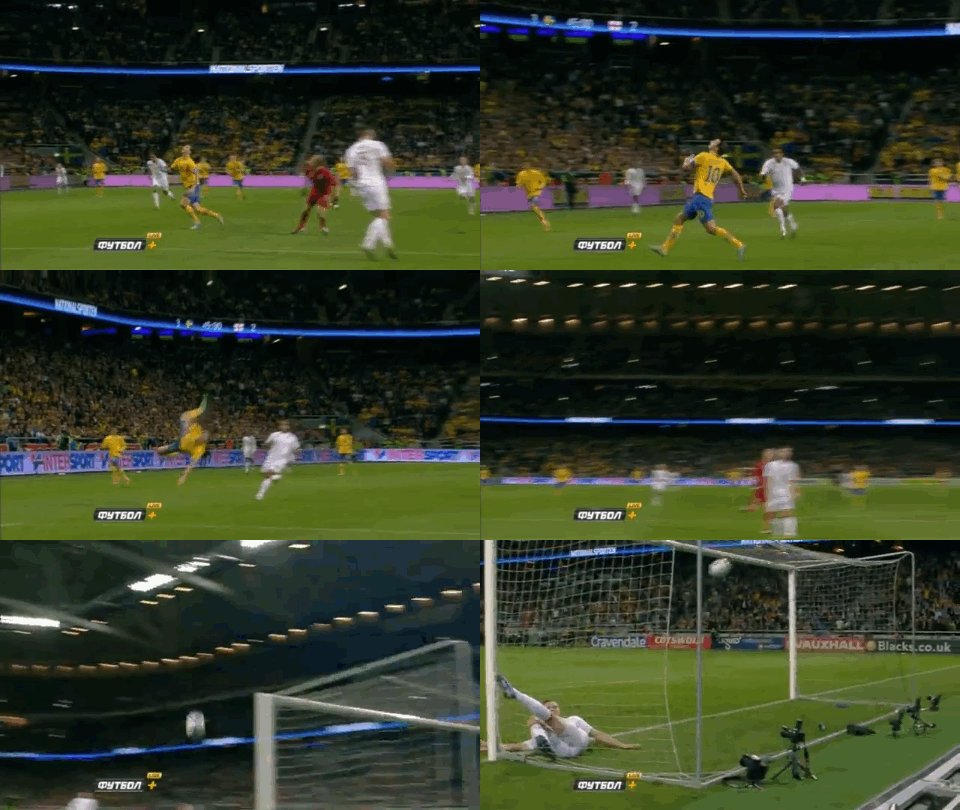
Hey guys I'm back, and today I'll be talking about motion. I know it has been a while, but I'm back. Motion is the movement of an object from one place to another. There are many different things that are related to motion, one of them being speed. An example of motion is the ball in the sport soccer or fĂștbol for you English people.
Another example is a bicycle kick like the one shown below
Think about walking to school, if it takes you 0.5 hours to walk 3 kilometers to school your average speed would be 4 km/h. Except you most likey didn't sustain the same speed throughout the walk.
Another example is a bicycle kick like the one shown below
Now I'll talk about relative motion. Relative motion is when an object changes it position from one place to another. One example is when one person starts out on one side of a tree and then moves to the other side of the tree. Another example of relative motion is if you are at the start line, then you pass the finish line that is also relative motion. Now lets talk about speed and the different types of speed.
Speed is how fast an object is moving. Speed is measured in Mph and Kmh. The speed of an object is measured by a speedometer. The speed of the ball changes (shown below).
There are two types of speed. They are average speed and instantaneous speed. Average speed is found by dividing the total distance traveled by the total time taken. Instantaneous speed is the speed of an object at one instant of time is the object's instantaneous speed.Think about walking to school, if it takes you 0.5 hours to walk 3 kilometers to school your average speed would be 4 km/h. Except you most likey didn't sustain the same speed throughout the walk.
Tuesday, December 17, 2013
Isaac Newton
Hey guys i'm back with a new topic. Today i'll be talking about Isaac Newton and about his many discoveries and accomplishments. Isaac Newton was born on Christmas Day, 1642, at Woolsthorpe Manor in England. On some calendars, you might notice Isaac Newton's birthday to be on January 4th, 1643. That's because two different calendars were used at that time.
Isaac Newton was born without a father, because his father died three months before Isaac was born. Isaac's mother left him with his grandparents to deal with so she could go marry some old guy. When Isaac was 19 years old, his mother came back and asked him to take over Woolsthorpe and become a farmer, but Isaac's uncle helped convince Isaac's mother to let him attend Cambridge University. Isaac took a three day journey to Cambridge University, but when he got there he knew that the three day walk was worth it. We all know how Isaac Newton discovered the Laws of Motion, hopefully.
One of the laws of motion is that an object in motion tends to stay in motion.
Isaac Newton was born without a father, because his father died three months before Isaac was born. Isaac's mother left him with his grandparents to deal with so she could go marry some old guy. When Isaac was 19 years old, his mother came back and asked him to take over Woolsthorpe and become a farmer, but Isaac's uncle helped convince Isaac's mother to let him attend Cambridge University. Isaac took a three day journey to Cambridge University, but when he got there he knew that the three day walk was worth it. We all know how Isaac Newton discovered the Laws of Motion, hopefully.
One of the laws of motion is that an object in motion tends to stay in motion.
Another one of the Laws of motion is that the sum of the forces on an object is equal to the total mass of that object. The last law of motion is when one body exerts a force onto a second body.
That's all for today people.
Sunday, December 8, 2013
Heat Transfer
Hey guys i'm back with a new topic. Today i'll be talking about heat and the details of what heat is and how it helps us all during our daily lives. First off, heat is the transfer of thermal energy from one object to another when the objects are at different temperatures. The amount of thermal energy that is transferred when two objects are brought into contact depends on the difference in temperature between the objects. Heat is important to us and our lives because it keeps us warm so we are able to live.
Heat is transferred in three ways. They are radiation, conduction, and convection. Radiation is when energy is transferred by electromagnetic waves. These waves carry energy through empty space, and also through matter. The transfer of thermal energy by radiation can occur in solids, liquids, and gases.

Conduction is when the particles in a material collide with other close particles. If you were to hold an ice cube in your hand, the faster-moving molecules in your hand bounce against the slower-moving molecules in the ice. The heat from your hand transfers to the colder ice, the molecules in the ice begin to move faster. As a result, the ice becomes warmer and its temperature rises. Finally, there is convection.
Convection is when thermal energy by the movement of atoms or molecules is transferred from one part of a material to another. When you heat a pot of water on a stove, thermal energy can be transferred through the water. Convection occurs in gases and liquids, not in solids.
Heat is transferred in three ways. They are radiation, conduction, and convection. Radiation is when energy is transferred by electromagnetic waves. These waves carry energy through empty space, and also through matter. The transfer of thermal energy by radiation can occur in solids, liquids, and gases.
Convection is when thermal energy by the movement of atoms or molecules is transferred from one part of a material to another. When you heat a pot of water on a stove, thermal energy can be transferred through the water. Convection occurs in gases and liquids, not in solids.
That's all for today guys see you next time!
Friday, December 6, 2013
Lemons Sharks
Hey guys i'm back with a new topic. Today i'll be talking about lemon shark reproduction. I know it might seem a little weird but trust me it's normal. Reasearchers say that they have found the first direct evidence that female lemon sharks return to where they were born to breed.
Even though lemon sharks are highly migratory, female lemon sharks prefer to go to where they were born themselves to breed. The researchers also stated that this should mean that fishing in specific places should be restricted. Not only has it been seen in lemon sharks, but it has also been seen in salmon and also sea turtles.
That's all for today guys see you next time.
Even though lemon sharks are highly migratory, female lemon sharks prefer to go to where they were born themselves to breed. The researchers also stated that this should mean that fishing in specific places should be restricted. Not only has it been seen in lemon sharks, but it has also been seen in salmon and also sea turtles.
That's all for today guys see you next time.
Wednesday, November 13, 2013
Energy
Hey people, today i'll be talking about energy and the many types of energy. First, energy is what is used to make electricity and it's also what you are using right now. There are two types of energy, there is kinetic energy and potential energy. Kinetic energy is when something is in motion. Mass and speed play a big part in kinetic energy.
The other type of energy is Potential energy. Potential energy is when something is having the potential of being put into motion. An example for Kinetic energy is a ball being kicked and is put into motion. An example for Potential energy is a boulder sitting on the point of a cliff and is having a potential to fall off of the cliff point. Mass for Kinetic energy has a big part because the bigger it is, also helps with the speed of the object. Mass has the same effect with Potential energy.

Kinetic energy depends on speed because it determines on how fast the object goes. An example for Kinetic energy transferring from one object to another is a bowling ball being put into motion and hitting a bowling pin and the bowling pin being put into motion by the bowling ball, which making the pin hit another pin and then another pin and so forth, creating the so called domino effect.
That's all for today people see you next time!
The other type of energy is Potential energy. Potential energy is when something is having the potential of being put into motion. An example for Kinetic energy is a ball being kicked and is put into motion. An example for Potential energy is a boulder sitting on the point of a cliff and is having a potential to fall off of the cliff point. Mass for Kinetic energy has a big part because the bigger it is, also helps with the speed of the object. Mass has the same effect with Potential energy.
That's all for today people see you next time!
Monday, November 11, 2013
States of Matter
Matter can also change to different states because of temperature and also because of pressure. When matter changes states it only changes physically, not chemically. An example is ice going from a solid to water, a liquid. Even though its form changed, its physical properties were the only thing that changed with it. Matter's chemical properties never change, they always stay the same.
Also, everything has their own melting and boiling points. A melting point is which a solid becomes a liquid. An example of a melting point is ice. Another part that is included in the states of matter is something called heat of fusion. Heat of fusion is the energy required to change a substance like a solid to a liquid, without changing its temperature. This energy breaks down the solid bonds, but it leaves a significant amount of energy associated with the molecular forces of the liquid state.
That's all for today people see you next week!
Subscribe to:
Posts (Atom)